Mindfulness
Nine Perfect StrangersMindfulness is presented in the novel as a practice of attending to present experience, but not as an uncomplicated route to peace or wisdom. At Tranquillum House it takes concrete forms—slow, measured eating, silent observation, and daily attention to the body—while Napoleon’s memories of Zach expose a darker tension: a life lived moment by moment can leave too little room for thought about consequences. The concept’s meaning therefore shifts with context, from a discipline that quiets repetitive thought to an ideal that cannot undo loss or protect those who follow it.
Practice at Tranquillum House
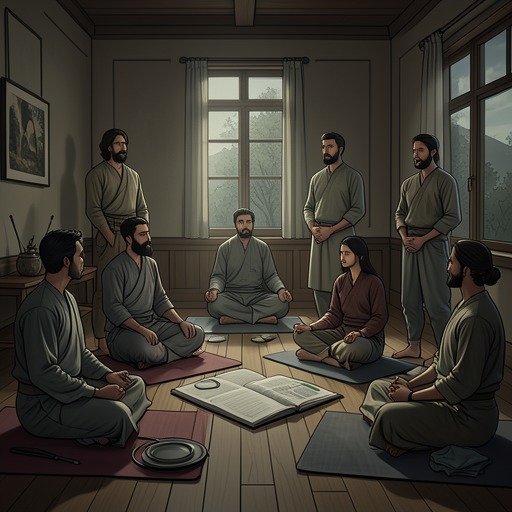
At dinner, mindfulness is made into a rule of conduct. A card at each place setting instructs guests to take small bites, put down their cutlery after every mouthful, close their eyes, and chew for at least fourteen seconds. The exercise turns eating into an explicitly managed sequence of sensations and actions. For Frances, already hungry and facing what she sees as an insufficient meal, the instruction feels less like spontaneous awareness than another demand imposed by the retreat.
The scene also places the ideal beside the difficulty of attending to ordinary experience without judgment. Frances is acutely aware of the strangers’ chewing and cutlery scraping; the sounds distress her so much that she wonders whether she has a disorder associated with such noises. Yao and Delilah remain standing silently through the meal, while the guests are expected to eat without conversation. Mindfulness here is neither effortless nor uniformly soothing: the same close attention encouraged by the card can sharpen Frances’s awareness of discomfort, hunger, and the strain of enforced silence.
Silence and the movement of thought
As the days pass, the retreat’s noble silence changes in Frances’s experience. At first it seems flimsy, arbitrary, and easy to break; with the intensifying summer heat, it acquires a weight and permanence she compares to the dry, still, bright-white atmosphere around her. The silence is not merely the absence of speech. It alters how she encounters both her thoughts and the other guests, making quiet attention an increasingly substantial condition of daily life.
Without conversation to interrupt her, Frances’s mind initially circles through the romance scam involving Paul Drabble, the money she lost, the hurt and anger, the uncertainty surrounding his son, and the failure of her book and career. The thoughts repeat without producing a solution or a revelation. Yet observing the loop appears to slow it: eventually, for brief periods, her mind becomes empty. Those intervals bring her relief, not because the losses have been resolved, but because attention lets the repetitive sequence stop for a while.
The silence also changes the social meaning of shared space. Guests can pass one another without greeting, or enter the hot spring with their eyes averted, and such noninteraction becomes ordinary rather than hostile. In the Secret Grotto, Frances sits beside the tall, handsome guest in silence, both looking out over the valley and absorbed in private thoughts. They do not speak or even look at one another, yet Frances feels that they have shared something spiritual. The episode distinguishes mindfulness from conversation: in this setting, attentive coexistence can feel like connection even when no exchange confirms it.
Zach and the danger of the immediate moment
The novel sets these practices against Napoleon’s understanding of his son. Zach had practised mindfulness and lived in the present, but Napoleon recalls that he was also impulsive, rarely thinking through what he did or considering what might follow. The examples are concrete and ordinary: running after waves could leave new runners wet for the day; going outside when the pollen count was high could bring on an asthma attack. Napoleon remembers warning Zach that some choices had consequences that could not be reversed. The contrast makes mindfulness’s emphasis on the present uneasy: attention to what is happening now does not, by itself, guarantee care for what happens next.
After Zach’s death, Napoleon repeatedly examines the morning in the form of an imagined alternative. He sees himself reaching for the phone and pressing snooze, then imagines the life in which he instead turns off the alarm, gets out of bed, and knocks on Zach’s door to invite him paddling. In that counterfactual, Napoleon still has his wife and daughter as he remembers them, and a son approaching his twenty-first birthday. The imagined invitation becomes the missed interruption around which his guilt gathers. The passage does not establish that getting up would have saved Zach; it shows how grief turns an ordinary decision into a recurring possibility that Napoleon cannot stop testing against what happened.
Napoleon’s professional identity deepens the contradiction. Former students and their parents had thanked him for helping boys through difficult periods, and he had been regarded as a teacher who could recognize when a boy was in trouble. Yet he feels that he failed his own son, the boy who mattered most to him. The gap between his knowledge of other boys and his inability to prevent Zach’s death shows the limits of any doctrine of attention: awareness and care cannot grant a parent full command over another person’s choices or over the circumstances of a death.
Memory, grief, and the limits of presence
Mindfulness also shapes the way Zach remains present to his family. Zoe finds it painful to say her twin brother’s name and recalls having changed her birthday rather than celebrating on the date she shared with him. She describes being angry because his death seemed to leave her carrying the hurt indefinitely. After a vivid experience in which she feels that they have spoken again, however, she says that it felt as if they had talked. Her account does not erase the anger or establish what the encounter was; it marks a change in how she can hold the relationship, allowing remembered connection to exist alongside grief.
That scene resonates with Frances’s own report that she felt she had spoken with her dead friend Gillian and her father. She tells Zoe that the experience felt different from a dream and more vivid than ordinary life; Zoe asks whether they might really have seen the dead. The conversation leaves the experience open rather than proving an explanation. In this context, attention to an intense present experience supports a moment of mutual recognition between Frances and Zoe, while uncertainty remains part of what they share.
Elsewhere, the novel presents a very different relationship between immediate experience and loss in Masha’s recollection of her infant son. She remembers finishing a task, opening his bedroom door, and asking whether he had tired of waiting; he was already dead, having strangled himself with the long white cord from the window blind. The everyday interval—she thought she needed only a few more minutes—becomes inseparable from the irreversible event. Read beside Napoleon’s repeated vision of the snooze button, the scene shows how bereaved parents return to small acts and missed moments, imagining a different present that might have led elsewhere.
The concept’s force lies in this tension rather than in a promise that presence alone can resolve suffering. At Tranquillum House, observing thoughts can loosen their repetitive hold, and silent attention can make a wordless encounter feel meaningful. But Zach’s impulsiveness, Napoleon’s counterfactual guilt, Zoe’s changed birthday, and Masha’s memory of the bedroom all show that the present is neither self-sufficient nor controllable. Mindfulness offers a way of noticing experience; it does not turn that notice into certainty about the future or mastery over loss.